ML to Oz

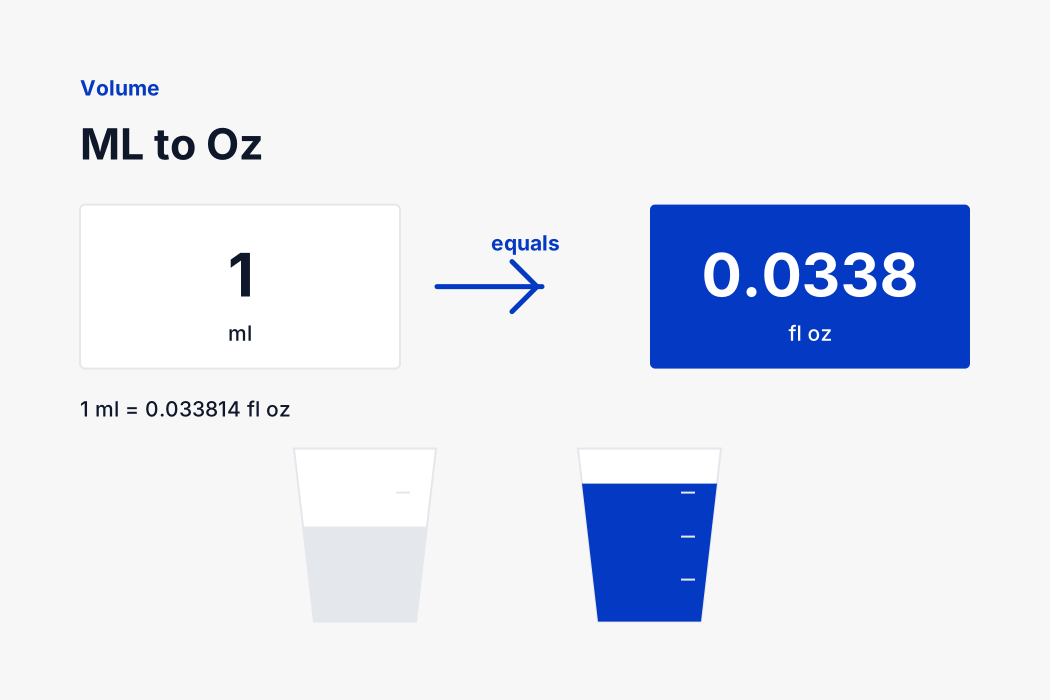
1 ml = 0.0338 fl oz

Exact factor Nothing uploaded Works offline No sign-up
ml
fl oz

1 ml = 0.0338 fl oz

Quick values

A fluid ounce is a volume, not a weight

The most common mistake here is treating fluid ounces as ounces. They are entirely different units that share a name. An ounce is a weight of 28.35 grams. A US fluid ounce is a volume of 29.5735 millilitres. They only coincide for water, and even then only roughly.

As with gallons, there are two fluid ounces. The US one is 29.5735 ml and the UK imperial one is 28.4131 ml, about four percent smaller. This converter uses the US figure, which is what almost every recipe and product label online means.

A useful anchor: 30 ml is almost exactly one US fluid ounce, and a standard 330 ml can is 11.16 fluid ounces, which is why the American equivalent is sold as a 12 ounce can and is genuinely larger.

A measuring jug with millilitre and fluid ounce scales printed on it
How it works

Type, read, done

There is no convert button and no page reload. The answer updates on every keystroke.

1

Type your figure

Put a number of millilitres into the left box. Decimals, negatives and very large values all work.

2

Read the answer

The us fluid ounces figure appears as you type, along with the full sentence underneath so you can copy it whole.

3

Adjust or reverse

Change the decimal places, tap a quick value, or press swap to convert us fluid ounces back to millilitres.

The formula

A US fluid ounce is one one hundred and twenty eighth of a US gallon, which is exactly 29.5735295625 millilitres.

fl oz = ml × 0.033814022702

To go the other way: ml = fl oz ÷ 0.033814022702

Worked through with a real number, 100 ml becomes 3.3814 fl oz. The calculation at the top of the page runs the same arithmetic as you type, to as many decimal places as you ask for.

Millilitres to US fluid ounces conversion chart

Every value below is calculated with the exact factor rather than a rounded one, then displayed to 4 decimal places. Read it on screen or print the page, since the chart carries no scripts and needs no connection.

MillilitresUS fluid ouncesMillilitresUS fluid ounces
5 ml0.1691 fl oz200 ml6.7628 fl oz
10 ml0.3381 fl oz250 ml8.4535 fl oz
15 ml0.5072 fl oz330 ml11.1586 fl oz
30 ml1.0144 fl oz500 ml16.907 fl oz
50 ml1.6907 fl oz750 ml25.3605 fl oz
100 ml3.3814 fl oz1,000 ml33.814 fl oz
150 ml5.0721 fl oz2,000 ml67.628 fl oz

The values people look up most

These are the millilitres figures that get searched for by name, worked out with the exact factor rather than a rounded one.

  • 5 ml is 0.1691 fl oz.
  • 15 ml is 0.5072 fl oz.
  • 50 ml is 1.6907 fl oz.
  • 150 ml is 5.0721 fl oz.
  • 250 ml is 8.4535 fl oz.
  • 500 ml is 16.907 fl oz.

Anything not on this list can be typed into the converter at the top of the page, which handles decimals, very large numbers and negative values without rounding until you ask it to.

Everyday volumes in fluid ounces

The sizes you are most likely to be converting, in US fluid ounces.

  • 15 ml is 0.51 fl oz, one tablespoon.
  • 30 ml is 1.01 fl oz, a single shot in most of the world.
  • 250 ml is 8.45 fl oz, close to an American cup.
  • 330 ml is 11.16 fl oz, a European drinks can.
  • 500 ml is 16.91 fl oz, a standard water bottle.
  • 1 litre is 33.81 fl oz.

The conversion also matters for cabin baggage rules, where the 100 ml liquid limit is described as 3.4 fluid ounces, and for medicine dosing where a syringe may be marked in one unit and the instructions written in the other.

The messiest family of units there is

Volume is where the imperial system fell apart most thoroughly. Britain redefined its gallon in 1824 as the volume of ten pounds of water, while America kept the older wine gallon of 231 cubic inches. The two have differed by twenty percent ever since, and every unit derived from them, the quart, the pint and the fluid ounce, inherited the split.

The metric side has no such problem. A litre is a thousand cubic centimetres, a millilitre is one, and everything scales by powers of ten. Converting millilitres to us fluid ounces is only complicated because of what happened on the imperial side of the line.

The practical defence is to look for the source of any figure before converting it. A recipe that says pint without saying which pint is ambiguous by twenty percent, which is enough to notice in almost anything you cook.

Check which definition your millilitres figure came from

Volume has more competing definitions than any other family of units. Two gallons, two fluid ounces, three cups and two pints are all in common use, and the gaps between them run from four to twenty percent.

Before converting, work out which system your number came from. American recipes and product labels use US customary units. British recipes, especially older ones, use imperial. Australian recipes use metric cups and spoons. A figure copied without its source is the one thing this converter cannot fix for you, because millilitres means different amounts in different places.

Where a recipe gives weights as well as volumes, use the weights. They carry no ambiguity, they survive any conversion, and they do not depend on how tightly an ingredient was packed into the measure.

Nothing is sent anywhere

This converter is a few lines of arithmetic running in your browser. There is no server call when you type, no account to create and no limit on how many times you use it. Open the page once and it keeps working with the connection switched off, which is genuinely useful on a building site, in a shop with no signal or on a plane.

That also means the page loads in well under a second and responds as fast as you can type. A converter that posts every keystroke to a server cannot do either of those things, and there is no reason a multiplication by 0.033814022702 should need one.

If you need the reverse direction, the swap button flips the two sides without reloading the page, so you can move between millilitres and us fluid ounces as often as you like. The decimal places control sits beside it, and both settings apply immediately to whatever number is already in the box.

Checking the answer yourself

Every figure on this page can be verified by hand, which is the point of showing the formula and the factor rather than just printing a result. Take 1,000 ml, apply the formula above, and you should land on the same us fluid ounces figure the converter gives.

If your own calculation differs in the last decimal place, the cause is almost always a rounded factor. Pocket calculators and spreadsheets often carry a shortened version, and over a large number that small difference becomes visible. The converter here uses the full value throughout and rounds only for display, so the number you copy is the number the definition gives.

Where a document, a form or a specification states its own conversion factor, use theirs rather than ours. Some industries deliberately work to a rounded figure for consistency, and matching the paperwork matters more than being marginally more precise than it.

FAQ

ML to Oz

The questions people ask most about this conversion.

A US fluid ounce is 29.5735 ml. A UK imperial fluid ounce is 28.4131 ml.

No. A fluid ounce measures volume and an ounce measures weight. They are only interchangeable for water, and only approximately.

100 ml is 3.38 US fluid ounces, which is why the airport liquid limit is described as 3.4 fl oz.

A US shot is 44.36 ml, which is 1.5 fluid ounces. Most of the rest of the world pours a 30 ml or 25 ml measure.

Yes, completely. There is no account, no usage limit and no paid tier. The conversion runs in your browser, so it costs us nothing to give you and nothing to run.

It uses the exact defined factor of 0.033814022702 rather than a rounded one, and JavaScript carries about fifteen significant digits. The precision you see is set by the decimal places control, not by any limit in the maths.

Yes. Once the page has loaded, every conversion happens on your device. You can switch off your connection and the converter above will carry on working normally.

No. Nothing you type is transmitted, logged or stored. The arithmetic runs entirely in the page and the values disappear when you close the tab.

Press the swap button between the two boxes. It reverses the direction in place, keeps the number you were looking at and applies the inverse formula.

Yes. The layout stacks on a narrow screen, the number fields open a numeric keypad, and the whole page is a few kilobytes so it loads on a slow mobile connection.

Yes. Ml to ounces and ml to oz conversion: the same conversion, written the way different people write it, and this page does all of them.

Need a different conversion?

Over a hundred free tools, all running in your browser. Nothing is uploaded and nothing is capped.