Celsius to Kelvin

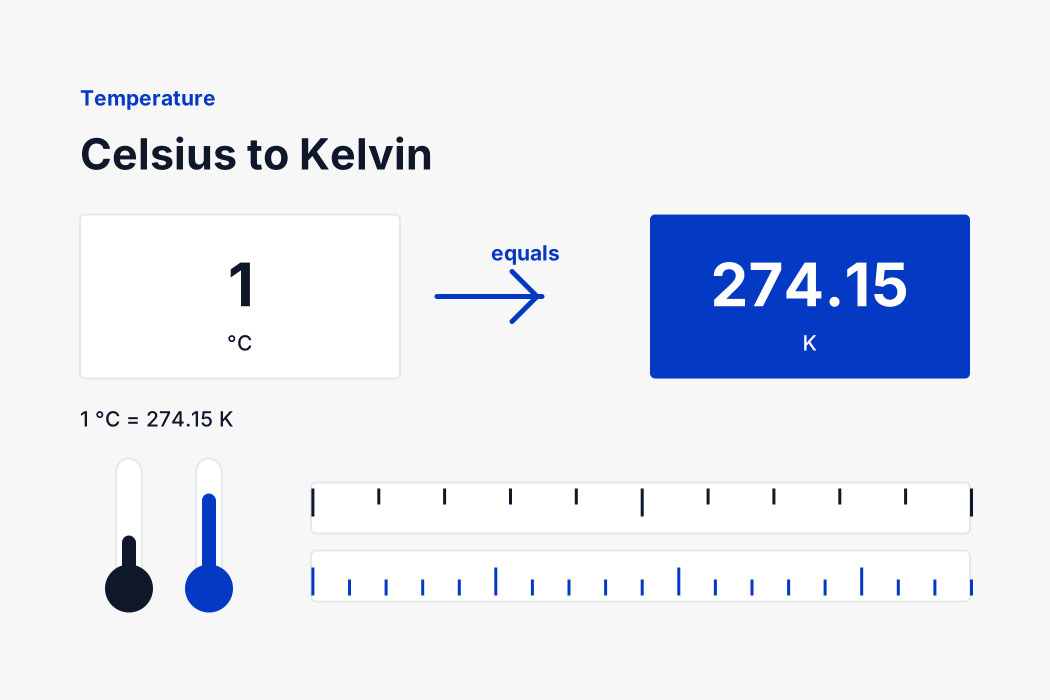
0 °C = 273.15 K

Exact factor Nothing uploaded Works offline No sign-up
°C
K

0 °C = 273.15 K

Quick values

Same degree, different zero

A kelvin and a degree Celsius are exactly the same size. The only difference between the two scales is where they put zero, so the conversion is a single addition: add 273.15 and you are done.

Celsius sets zero at the freezing point of water. Kelvin sets it at absolute zero, the point where all thermal motion stops, which is 273.15 degrees colder. That makes Kelvin an absolute scale, and it is why every gas law, thermodynamic equation and blackbody calculation uses it.

Note the convention: you write 300 K, not 300 °K. Kelvin took the degree symbol out of its name in 1967, because a kelvin is a unit in its own right rather than a degree on a relative scale.

A laboratory temperature readout showing Celsius and Kelvin side by side
How it works

Type, read, done

There is no convert button and no page reload. The answer updates on every keystroke.

1

Type your figure

Put a number of celsius into the left box. Decimals, negatives and very large values all work.

2

Read the answer

The kelvin figure appears as you type, along with the full sentence underneath so you can copy it whole.

3

Adjust or reverse

Change the decimal places, tap a quick value, or press swap to convert kelvin back to celsius.

The formula

A kelvin and a degree Celsius are the same size. Only the zero point differs: 0 K is absolute zero, which is 273.15 degrees below the freezing point of water.

K = °C + 273.15

To go the other way: °C = K − 273.15

Take 25 °C. Add 273.15 and you have 298.15 K, the figure used for standard laboratory conditions. The calculation at the top of the page runs the same arithmetic as you type, to as many decimal places as you ask for.

Celsius to Kelvin conversion chart

Every value below is calculated with the exact factor rather than a rounded one, then displayed to 2 decimal places. Read it on screen or print the page, since the chart carries no scripts and needs no connection.

CelsiusKelvinCelsiusKelvin
-273.15 °C0 K25 °C298.15 K
-100 °C173.15 K30 °C303.15 K
-40 °C233.15 K37 °C310.15 K
-20 °C253.15 K50 °C323.15 K
0 °C273.15 K100 °C373.15 K
10 °C283.15 K200 °C473.15 K
20 °C293.15 K500 °C773.15 K

The values people look up most

These are the celsius figures that get searched for by name, worked out with the exact factor rather than a rounded one.

  • -273.15 °C is 0 K.
  • -40 °C is 233.15 K.
  • 0 °C is 273.15 K.
  • 20 °C is 293.15 K.
  • 30 °C is 303.15 K.
  • 50 °C is 323.15 K.

Anything not on this list can be typed into the converter at the top of the page, which handles decimals, very large numbers and negative values without rounding until you ask it to.

Where Kelvin is the only correct unit

Kelvin is not a preference, it is a requirement in several places, because the maths breaks with a relative scale.

  • Gas laws, where pressure and volume are proportional to absolute temperature. Using Celsius gives nonsense as soon as you go below zero.
  • Colour temperature in photography and lighting, where 2700 K is warm white and 6500 K is daylight.
  • Thermodynamics and heat transfer, where efficiency calculations depend on absolute temperature ratios.
  • Astronomy, where stellar surface temperatures run from about 3000 K to over 30,000 K.
  • Cryogenics, where liquid nitrogen at 77 K and liquid helium at 4.2 K are far more naturally expressed than as negative Celsius figures.

Why three scales exist at all

Fahrenheit came first, in 1724, built around a freezing brine mixture at zero and roughly human body temperature near ninety six. Celsius followed in 1742 and anchored itself to something everyone could reproduce: water freezing and boiling, zero and a hundred. Kelvin arrived in 1848 and moved zero to the coldest temperature physically possible.

Celsius won almost everywhere because its reference points are easy to reproduce in any laboratory. Fahrenheit survives in the United States and a handful of other places, largely through habit rather than any technical argument. Converting celsius to kelvin means moving between two of those histories.

Modern definitions have moved on again. Since 2019 both the kelvin and, through it, the Celsius degree have been defined by the Boltzmann constant rather than by the properties of water, so the scales no longer depend on measuring anything physical at all.

Where an approximate celsius reading goes wrong

Temperature is the conversion where mental shortcuts fail most visibly, because the two step formula means an error compounds instead of staying proportional. Doubling and adding thirty is close around room temperature and out by eighteen degrees at boiling point.

For a weather forecast, a degree either way changes nothing. For an oven it changes a bake, which is why the chart above gives exact figures rather than dial settings. For anything medical, use the exact conversion: the gap between 38.0 and 38.5 degrees Celsius is the difference between a mild and a notable fever, and that is under one degree Fahrenheit.

In scientific work, carry the full conversion through the calculation and round only the printed result. Rounding a temperature before a thermodynamic step can move the final answer by several percent.

Nothing is sent anywhere

This converter is a few lines of arithmetic running in your browser. There is no server call when you type, no account to create and no limit on how many times you use it. Open the page once and it keeps working with the connection switched off, which is genuinely useful on a building site, in a shop with no signal or on a plane.

That also means the page loads in well under a second and responds as fast as you can type. A converter that posts every keystroke to a server cannot do either of those things, and there is no reason a multiplication by 1 should need one.

If you need the reverse direction, the swap button flips the two sides without reloading the page, so you can move between celsius and kelvin as often as you like. The decimal places control sits beside it, and both settings apply immediately to whatever number is already in the box.

Checking the answer yourself

Every figure on this page can be verified by hand, which is the point of showing the formula and the factor rather than just printing a result. Take 100 °C, apply the formula above, and you should land on the same kelvin figure the converter gives.

If your own calculation differs in the last decimal place, the cause is almost always a rounded factor. Pocket calculators and spreadsheets often carry a shortened version, and over a large number that small difference becomes visible. The converter here uses the full value throughout and rounds only for display, so the number you copy is the number the definition gives.

Where a document, a form or a specification states its own conversion factor, use theirs rather than ours. Some industries deliberately work to a rounded figure for consistency, and matching the paperwork matters more than being marginally more precise than it.

FAQ

Celsius to Kelvin

The questions people ask most about this conversion.

Add 273.15. So 25 °C is 298.15 K. The degree size is identical, so nothing needs scaling.

Minus 273.15 °C, which is 0 K. It is the lowest temperature that can exist, and nothing has ever reached it.

Because it is an absolute unit, not a degree on a relative scale. The correct form is 300 K, and it has been since 1967.

Around 293 to 298 K, which is 20 to 25 °C. Scientific standard conditions usually use 298.15 K.

Yes, completely. There is no account, no usage limit and no paid tier. The conversion runs in your browser, so it costs us nothing to give you and nothing to run.

It uses the exact defined factor of 1 rather than a rounded one, and JavaScript carries about fifteen significant digits. The precision you see is set by the decimal places control, not by any limit in the maths.

Yes. Once the page has loaded, every conversion happens on your device. You can switch off your connection and the converter above will carry on working normally.

No. Nothing you type is transmitted, logged or stored. The arithmetic runs entirely in the page and the values disappear when you close the tab.

Press the swap button between the two boxes. It reverses the direction in place, keeps the number you were looking at and applies the inverse formula.

Yes. The layout stacks on a narrow screen, the number fields open a numeric keypad, and the whole page is a few kilobytes so it loads on a slow mobile connection.

Yes. Kelvin to celsius, celcius to k and c to kelvin: the same conversion, written the way different people write it, and this page does all of them.

Need a different conversion?

Over a hundred free tools, all running in your browser. Nothing is uploaded and nothing is capped.