Image Resizer

Change the pixel size of an image in your browser. Nothing is uploaded.

Free, no limit Nothing uploaded No watermark Works on mobile

Drop your images here

JPG, PNG, WebP, AVIF, BMP and GIF. Nothing is uploaded.

Choose files

Pixels, not kilobytes, and the difference matters

Two different things are called making an image smaller, and asking for the wrong one is why people end up cropping photographs that never needed cropping.

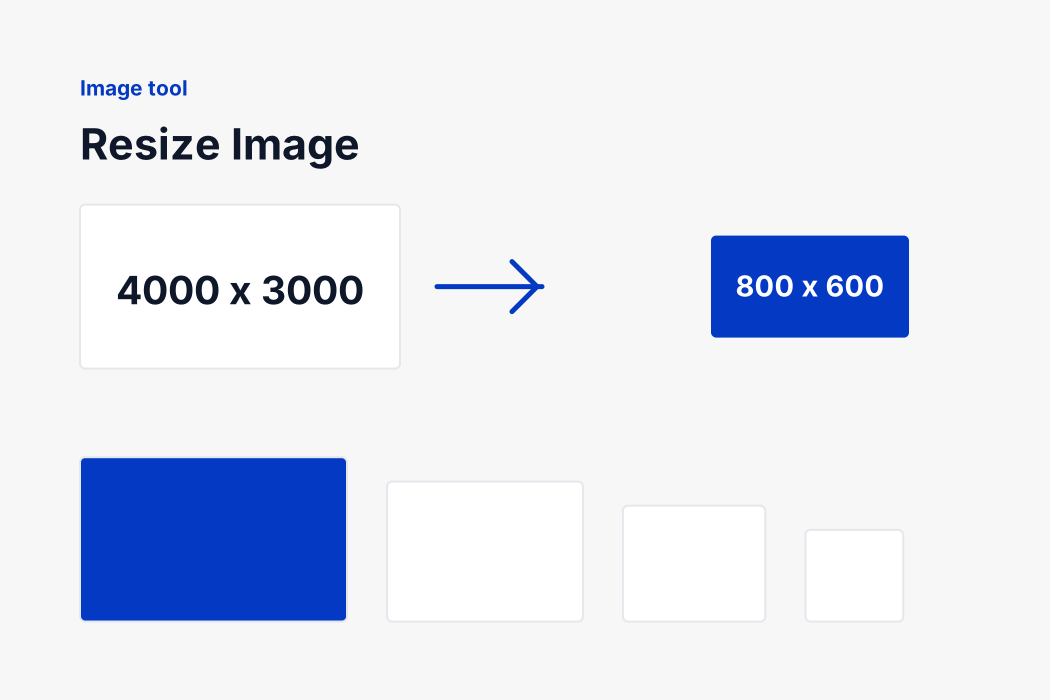
Resizing changes how many pixels there are. A 4000 by 3000 photograph becomes 800 by 600: a quarter of the width, a sixteenth of the pixels, and physically smaller wherever it is shown. That is what you want when a form asks for 800 by 600, when a website needs images that are not four times larger than the space they sit in, or when a 12 megapixel photograph is being emailed to somebody who will look at it on a phone.

Compressing leaves the picture exactly as large as it was and stores it with less data behind it. That is what you want when a form says the file must be under 200 KB. Our image compressor does that, and hits an exact target in kilobytes.

This page does the first one. Set a width, a height, a percentage, or a box to fit inside, and the shape of your picture is kept throughout.

A large photograph being reduced to smaller pixel dimensions
How it works

Three steps, no upload

Your browser decodes the picture and draws it again at the new size.

1

Add your images

Drop in as many as you like, or pick them from your device.

2

Say what size

A width, a height, a percentage, or a box to fit inside.

3

Download

Each file is named with its new dimensions. Take them singly or as a zip.

How the picture is redrawn

Your browser decodes the image into pixels, works out the new dimensions from what you asked for, and draws the whole picture onto a canvas of that size. Drawing at a different size is where the quality comes from or does not: the browser averages groups of pixels together rather than throwing every other one away, which is why a photograph reduced this way stays smooth instead of going ragged.

That canvas is then encoded, either in the format you started with or the one you chose. A JPEG comes out at a high quality setting, a PNG comes out lossless, and if the source had transparency and the target is JPG the clear areas are filled with white, because JPEG has no way to store them.

All of it happens on your machine. Nothing is uploaded, there is no queue, and a folder of forty photographs finishes in the time it takes to read this paragraph.

Sizes worth knowing

Where it is goingA sensible widthWhy
A web page, full width1600 pxCovers a large screen without being four times the space it sits in.
A web page, in a column800 pxTwice the drawn size, which keeps it sharp on a high resolution screen.
A thumbnail400 pxSmall enough to load instantly and big enough to see.
Email1200 pxLooks right on any screen and does not fill somebody's inbox.
A passport style photograph600 pxEnough for a printed 35 by 45 mm at 300 DPI.
Printing at A42480 px300 DPI across 210 mm, which is what a printer can actually resolve.

The rule behind most of these is simple: about twice as many pixels as the space the image will occupy. A phone screen packs two or three real pixels into every one the page thinks it has, so an image drawn 400 wide wants to be around 800 to look sharp on it. More than that is bytes nobody sees.

Four requirements, worked out

"Maximum 800 by 600 pixels"

This is a box, not a size. Choose fitting inside a box, put 800 and 600 in, and a landscape photograph comes out 800 by 600 while a portrait one comes out 450 by 600. Both are inside the limit, and neither has been cut or squashed. Using width alone would give a portrait photograph a height of over a thousand, which the form would reject.

"Upload a photo, 200 by 230 pixels"

An exact size, which is the Indian exam portal standard. Fit inside a box of 200 by 230, then check the result: if your photograph is not already close to that shape, one side will come up short, and the honest fix is to crop it to roughly 200 by 230 in your phone's photo app first, then resize here.

"Images should be no more than 1MB"

A file size, so the direct answer is the compressor. But resizing first helps enormously: a 12 megapixel photograph reduced to 1600 pixels wide is usually already under a megabyte before any compression at all, and it looks better than the same file squeezed to 1 MB at full dimensions.

"Make these forty product photos the same size"

Drop the lot in with a width set. Every one comes out at that width, each keeping its own proportions, named with its own filename and the new dimensions. Take the whole set as a zip.

The pattern behind all four is the same question: is the requirement in pixels or in bytes? Pixels means resize, bytes means compress, and a requirement that mentions both means resize first and compress second.

The four ways to say what you want

  • By width. Give a width and the height follows, so the picture keeps its shape. This is the one to use for images going on a web page.
  • By height. The same in the other direction, for when a row of images has to line up.
  • By percentage. Halve everything, or take a quarter, without working out what that is in pixels. Over 100 enlarges, which is possible but rarely a good idea.
  • Fit inside a box. Give both numbers and the picture is scaled until one side touches, with the other having room to spare. Nothing is cropped and nothing is stretched, which is what a maximum size usually means.

Fitting inside a box is the one people misread. A 4000 by 3000 photograph fitted into 1000 by 1000 comes out 1000 by 750, not 1000 by 1000, because making it square would mean either squashing it or cutting a third of it off. If you genuinely want the exact box and do not mind the distortion, there is a switch for it.

Enlarging, and why it disappoints

A 400 pixel image asked to become 1600 does not gain detail. The browser invents the pixels in between by averaging their neighbours, which is why the result looks soft rather than sharp. Nothing can recover information that was never recorded. If you need a larger image, go back to the original file if there is one.

Your photographs stay on your device

Resizing is the most ordinary thing anybody does to an image, and it is also done to the least ordinary images: identity documents for an application, a photograph of a signature, a picture of a child for a school form.

An online resizer that works the usual way needs all of those on its server to do the job. This one does not, because the browser you are reading this in already contains an image decoder and a canvas, which is everything the job requires. Nothing is transmitted, nothing is stored, and there is nothing on our side to delete afterwards.

The simplest demonstration is to disconnect from the internet once the page has loaded. It carries on working, because there was never anything to send.

Resize, compress, or crop

Resize, which is this page

Changes how many pixels there are. Use it when the requirement is in pixels, or when the picture is simply far larger than the place it is going.

Compress, which is the next page along

Keeps every pixel and stores them with less data. Use it when the requirement is in kilobytes: 20 KB, 50 KB, 200 KB. It hits an exact number, which resizing cannot.

Crop

Cuts part of the picture away, changing what is in it rather than how big it is. That is a different job and not one this page does: nothing here removes any part of your image.

Both together

Common, and the right order is resize first, compress second. A smaller picture needs less compression to reach the same file size, so it comes out looking better than the same target reached by compression alone.

If something does not look right

The result is not the size I asked for

If you chose to fit inside a box, that is the point: the picture is scaled until one side touches and the other has room, so the shape is kept. Turn off "keep the picture's shape" to get the exact box, and accept the stretching that comes with it.

The image looks soft

Either it was enlarged, in which case nothing can be done because the detail was never there, or it was reduced very far in one step. Going from 6000 pixels to 200 loses a great deal by definition.

My transparent background went white

You saved as JPG, which cannot store transparency. Choose PNG or WebP to keep it.

The file got bigger

Possible if you changed format: a photograph saved as PNG is often larger than the same photograph as JPG, however few pixels it has, because PNG stores every one exactly. Keep the original format, or choose JPG.

My iPhone photos will not open

iPhones save as HEIC and only Safari can decode it. On an iPhone or a Mac this page reads them normally; in Chrome on a desktop it cannot. Convert them first with our HEIC to JPG page in Safari.

Nothing happens when I drop a file

Fill in the size first. With an empty width there is nothing to resize to, and the row says so rather than guessing.

Free, with no account and no watermark

No sign-up, no daily limit, no watermark and no cap on how many files or how large they are. The work happens on your computer, so there is nothing for us to charge for.

Each file keeps your own name with the new size added, so holiday.jpg becomes holiday-800x600.jpg, which means a folder of resized images is still sorted and still recognisable. Take them one at a time or the whole set as a zip.

If what you actually needed was a file under a certain number of kilobytes, our image compressor takes an exact target and finds the quality that meets it. And if the format is the problem rather than the size, the image converters handle that.

FAQ

Resize Image

The questions people ask most about resizing an image.

Drop it on the tool above and set a width. The height follows so the picture keeps its shape, and the resized file is ready straight away.

Resizing changes how many pixels there are, so the picture is physically smaller. Compressing keeps the picture the same size and stores it with less data. A form asking for 800 by 600 wants resizing; one asking for under 200 KB wants compressing.

Yes. Set a width and the height is worked out from it, or set a box and the picture is scaled to fit inside it. Nothing is stretched or cropped unless you deliberately turn that off.

Yes. Drop in as many as you like, all of them are resized with the same setting, and you can download them individually or as a single zip.

You can, and it will look soft. Enlarging invents pixels by averaging their neighbours; it cannot recover detail that was never recorded.

No. Your browser decodes and redraws them on your own device. Nothing is transmitted anywhere.

Yes, if you save as PNG or WebP. Saving as JPG fills transparent areas with white, because JPEG cannot store them.

About twice the space the image will occupy, because high resolution screens pack several real pixels into each one the page thinks it has. 800 pixels wide for a column, 1600 for a full width image.

Completely, with no sign-up, no limit and no watermark. The resizing costs us nothing because it runs on your device.

Yes, on both iPhone and Android. Pick images straight from your gallery and the results save to your downloads.

Yes. A photo resizer and a bulk image resizer all describe this page. The names differ because people describe the same job differently; the job itself does not change.

Need a different tool?

Over a hundred free tools, all running in your browser. Nothing is uploaded and nothing is capped.